

Executive Overview
Temperature-sensitive pharmaceutical shipments require careful monitoring throughout transportation. Traditional temperature data loggers provide valuable historical records, but the information may not become available until the shipment reaches its destination.
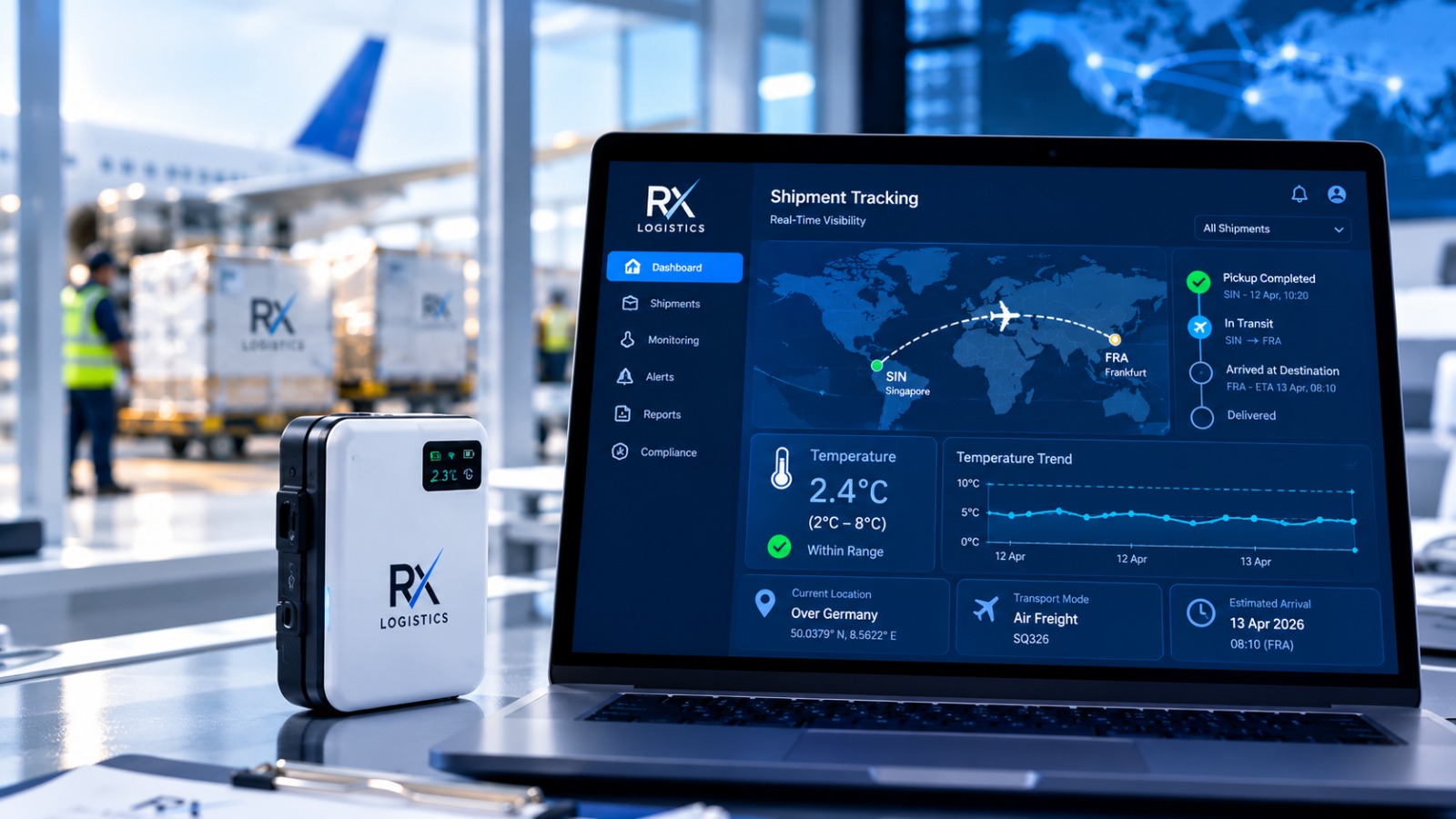
Connected Internet of Things (IoT) monitoring technologies offer additional capabilities by enabling temperature, location, and other shipment information to be transmitted during transportation. These technologies can help logistics teams identify potential temperature deviations, assess transportation disruptions, and coordinate proactive interventions.
1. The Logistics Scenario
The Operational Challenge
A pharmaceutical manufacturer needs to transport a sensitive biological shipment between two international continents. The journey involves 6 critical operational stages:
Potential challenges include flight delays, extended tarmac staging, and customs holds that could deplete thermal packaging buffers if left unnoticed.
2. Traditional Monitoring Versus IoT-Enabled Monitoring
Passive USB / RFID Loggers
- • Data is locked inside device until physical arrival and USB download.
- • Temperature deviations are only discovered after product delivery.
- • Zero opportunity for in-transit intervention or dry-ice replenishment.
- • High risk of retroactive lot rejection and quarantine delays.
Cellular & Satellite Multi-Sensor
- • Real-time data transmission of temperature, battery, and GPS coordinates.
- • Proactive threshold warning alerts dispatched via SMS/Email to control towers.
- • Enables intervention at intermediate airports or customs warehouses.
- • Live cloud visibility for both shippers, consignees, and QA teams.
3. The Proposed Monitoring Approach
For this illustrative shipment, pre-conditioned qualified thermal packaging (rated for 96 hours at +2°C to +8°C) is coupled with a cellular IoT data logger calibrated according to ISO/IEC 17025 standards. Alert parameters are configured with a warning threshold at +6.5°C and a critical threshold at +7.8°C to afford operational teams sufficient lead time.
4. Illustrative Temperature Alert Scenario
During international transit, an unexpected 8-hour tarmac transfer delay occurs at an intermediate airport hub under +38°C ambient heat. The monitoring platform detects that internal cargo temperature is creeping toward the threshold.
Alert Identification
Cloud monitoring system generates an automated alert: payload temperature reached +6.8°C with 4 hours remaining until next flight leg.
Initial Assessment
Control tower verifies exact GPS location: tarmac container pallet position. Thermal curve analysis projects potential excursion within 2.5 hours.
Operational Coordination
Logistics team contacts ground handling partner to move cargo immediately from tarmac sun to the airport’s temperature-controlled cold room (+4°C).
Customer Communication
The pharmaceutical client receives a documented incident log showing early alert detection and confirmed cold room placement.
Continued Monitoring
Sensors record temperature stabilization at +4.6°C. Cargo is safely reloaded onto the connecting flight under chilled tarmac priority.
Quality Review & Release
Upon final delivery, the full uninterrupted thermal log proves zero out-of-spec excursions occurred, allowing immediate batch release.
5. Key Operational Lessons
Define Monitoring Before Dispatch
Sensors, threshold triggers, and escalation rosters must be locked during pre-shipment planning.
Packaging & Monitoring Co-Dependence
Packaging shields against ambient physics; monitoring provides the data to navigate operational friction.
Alerts Require Defined Response Protocols
Data alerts are only as valuable as the ground network's ability to act upon them within hours.
Quality Decisions Require Product Evidence
Sensors provide thermal records, while the authorized quality person determines final product disposition.
6. How RX Logistics Supports Shipment Visibility
RX Logistics provides proactive control tower oversight across complex pharmaceutical cold chains. By aligning calibrated IoT sensor telematics with trained ground handlers and validated SOPs, our clients maintain end-to-end transparency across critical transit lanes.
Conclusion: Actionable Visibility
The real value of IoT monitoring lies not simply in collecting shipment data, but in using that real-time information to support proactive operational decisions and protect life-saving therapies.