
Supply Chain Overview
Pharmaceutical supply chains involve multiple organizations, transportation stages, and regulatory hurdles. From the movement of active pharmaceutical ingredients (APIs) to the nationwide distribution of finished prescription medicines, logistics provides the vital circulatory system of global healthcare.
Unlike general industrial cargo, pharmaceutical logistics requires specialized thermal protection, strict documentation, continuous traceability, and validated GDP compliance at every stage of the lifecycle.
1. Understanding the End-to-End Pharma Supply Chain
The pharmaceutical supply chain connects research, manufacturing, regulatory release, and patient dispensing. Transportation stages include:
Inbound Raw Materials & APIs
High-purity chemical APIs, biological intermediates, and sterile excipients transported under controlled ambient or refrigerated conditions to manufacturing plants.
Interfacility & Contract Manufacturing Transfers
Unfinished bulk tablets, sterile liquid vials, or lyophilized powders moving between primary chemical synthesis plants, formulation sites, and packaging facilities.
Finished Product Global Distribution
Commercial pharmaceuticals released by Qualified Persons (QPs) transported via international air freight and reefer ocean containers to regional distribution hubs.
Final-Mile Healthcare Delivery
Dedicated temperature-controlled vans and couriers delivering directly to hospital pharmacies, clinics, clinical research centers, and dispensing points.
2. Choosing the Right Multimodal Transport Strategy
Fastest for international, time-critical biologics, active pharmaceutical containers, and clinical supplies.
Cost-effective for high-volume commercial finished goods and generics with long shelf lives using active reefer containers.
Direct-door temperature-mapped vehicles for regional distribution, factory-to-airport transfers, and final delivery.
3. Integrated Coordination: The RX Logistics Solution
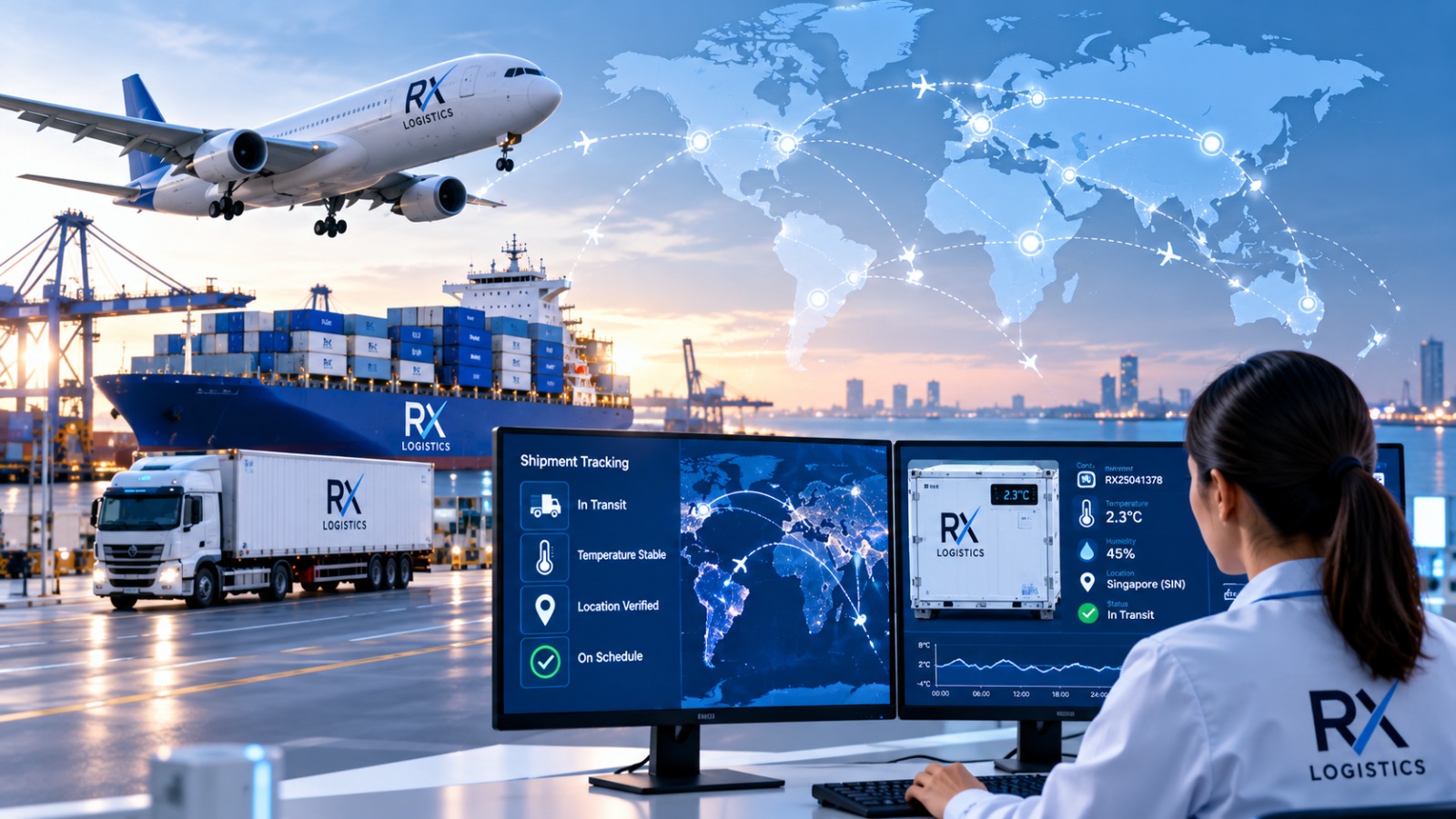
RX Logistics provides comprehensive life sciences logistics coordination connecting every link in your supply chain. We engineer transportation solutions with validated temperature packaging, GPS/cellular sensor monitoring, customs clearance facilitation, and GDP-compliant standard operating procedures.
Conclusion: Connected Precision
The strength of a global pharmaceutical supply chain depends not only on how medicines are synthesized in laboratories, but on how reliably and safely they are transported across borders to heal patients.